
 AZ
AZ 



NASA-nın MAVEN kosmik gəmisi Marsda ildırım kimi aktivliyin ilk dəlillərini aşkar edib

Krystal Kasal tərəfindən , Phys.org
redaktə edən: Gaby Clark , rəy verən: Robert Egan
Tercih edilən mənbə kimi əlavə edin
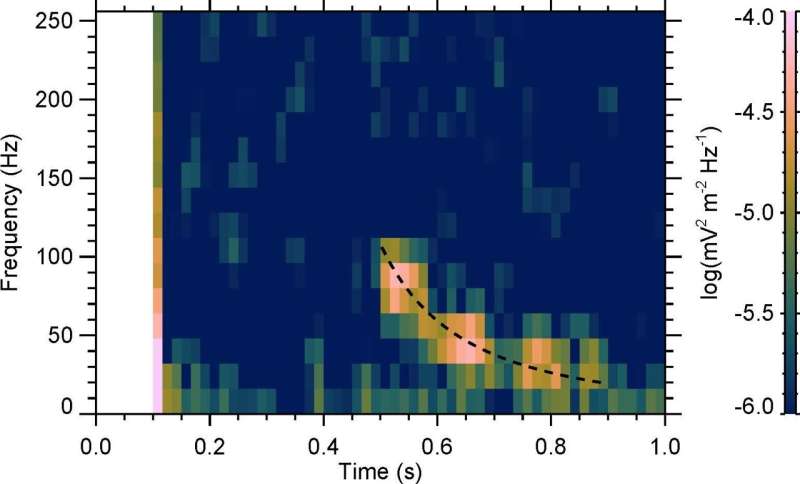
MAVEN tərəfindən ölçülən elektromaqnit dalğalarının tezlik-zaman spektroqramı. Kredit: Science Advances (2026). DOI: 10.1126/sciadv.aeb4898
NASA-nın Mars Atmosferi və Uçucu Təkamülü (MAVEN) kosmik gəmisi tərəfindən son on ildə toplanan geniş məlumatları araşdırarkən, elm adamları ildırımın yaratdığı tanış bir elektromaqnit siqnal növü aşkar etdilər. Bu nadir tapıntı Marsda ildırım aktivliyinin ilk birbaşa əlamətidir. Komanda bu yaxınlarda tapıntılarını Science Advances jurnalında dərc etdi və burada hadisəni və Marsda ildırım kimi aktivliyi aşkar etməyin niyə bu qədər çətin olduğunu təsvir etdi.
İldırım aşkarlanması üçün Whistler dalğaları
Fit dalğaları ildırımın yaratdığı aşağı tezlikli radio dalğa siqnallarıdır və maqnit sahəsi xətləri boyunca planetin maqnitosferində yayılan bir impuls yaradır. Fit dalğaları, aşağı tezliklərin ionosfer və maqnitosfer plazmasından daha yavaş sürəti səbəbindən dağılır. Bu dalğalar Yer kürəsində tipikdir, lakin Yupiter, Saturn və Neptunda da müşahidə edilmişdir. Bütün bu planetlərin hamısı güclü maqnit sahələrinə və müvafiq maqnitosferlərə malikdir və bu da fit dalğalarının hərəkətini asanlaşdırır.
Digər tərəfdən, Marsın qlobal, Yerə bənzər bir maqnit sahəsi yoxdur . Bunun səbəbi, bu maqnit sahələrinə səbəb olan daxili aktivliyin milyardlarla il əvvəl Marsda dayanmasıdır. Bu, Mars atmosferində ildırım kimi boşalmaların hələ müşahidə edilməməsinə səbəb ola bilər. Lakin Marsda ildırım kimi aktivlik qeyri-mümkün deyil.Fit çalanın əmələ gəlməsini göstərən sxem. Müəllif: Science Advances (2026). DOI: 10.1126/sciadv.aeb4898
“Simulations and laboratory experiments suggest that electric discharges are likely to occur in Martian dust storms similar to those observed in terrestrial volcanic eruptions and dust devils. During dust storms, dust grains become electrically charged through collisions,” the study authors explain.
The team goes on to say that when combined with certain atmospheric conditions, these dust storms can generate electrical discharges. These have been confirmed in laboratory experiments. And although there is no global magnetic field, Mars does have localized crustal magnetic fields scattered across its surface. These tend to be much stronger in the southern hemisphere than the north. And so, whistler waves can potentially travel along these field lines when generated from lightning-like activity from dust storms.
A highly unlikely detection
Out of over 108,000 measurements from MAVEN, the team found a single frequency-dispersed whistler wave in Mars’ ionosphere. The snapshot showed a clear whistler event, lasting 0.4 seconds and spanning up to 110 Hz. The team conducted theoretical modeling that confirmed the plausibility of the wave propagation from the surface to the spacecraft. And although the team notes that they cannot pinpoint the exact location of the discharge or whether it came from a dust storm, they say that the data closely resembles that of lightning-generated whistler waves on Earth.
Because only one of these events has now been detected, it’s clear that lightning-like events on Mars are elusive. To catch even the one event, several conditions had to be met. For example, the localized magnetic field had to be strong enough and vertical in order to be detected by the orbiter. Specific ionospheric conditions were also required. On top of that, the measurement had to be taken from a very specific place (the side of Mars experiencing night conditions) at a specific time (when the magnetic field was oriented vertically).
The team writes, “We note that while nightside ionospheric conditions were present in about one-third of the analyzed wave snapshots, these high magnetic field inclinations are extremely rare; fewer than 1% of the investigated wave snapshots (679 in total) were measured at locations with these high values, and only 290 of them at SZA > 100°.
“This suggests that although lightning-like electric discharge processes can occur on Mars, the ionospheric properties often preclude the formation of a detectable whistler. In addition, the discharges themselves may be infrequent or weak, possibly due to additional processes hindering breakdown electric field generation.”
Thanks to MAVEN being in the right place at the right time, scientists now know a little more about conditions on Mars. This information can help plan future missions and contribute to our understanding of planetary atmospheres and comparative planetology.
Müəllifimiz Krystal Kasal tərəfindən sizin üçün yazılmış, Qeby Clark tərəfindən redaktə edilmiş və Robert Egan tərəfindən faktlar yoxlanılmış və nəzərdən keçirilmiş — bu məqalə diqqətli insan əməyinin nəticəsidir. Müstəqil elmi jurnalistikanı yaşatmaq üçün sizin kimi oxuculara güvənirik. Bu reportaj sizin üçün vacibdirsə, xahiş edirik ianə etməyi düşünün (xüsusilə aylıq). Təşəkkür olaraq reklamsız hesab əldə edəcəksiniz .
Nəşr detalları
František Němec və digərləri, Marsda ildırım tərəfindən yaradılan dalğalar, Elmdə irəliləyişlər (2026). DOI: 10.1126/sciadv.aeb4898
Jurnal məlumatları: Elmin irəliləyişləri
Əsas anlayışlar
© 2026 Science X Network