
 AZ
AZ 






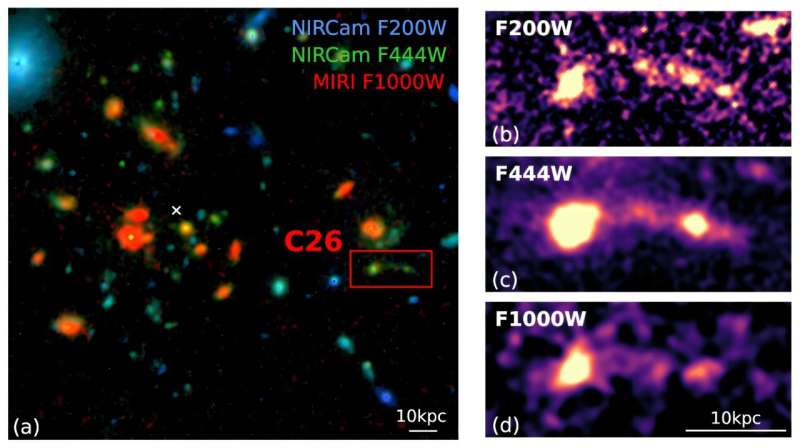
Astronomlar ölmə prosesində olan erkən bir qalaktikanı aşkar etmiş ola bilərlər

edited by Gaby Clark, reviewed by Robert Egan
Credit: CC0 Public Domain
The state of the Atlantic Meridional Overturning Circulation (AMOC) has been a hot topic among climate scientists in recent years. The AMOC is crucial for climate regulation because it pulls warm surface water from the tropics north and sends colder, deeper water south, redistributing large amounts of heat, helping to sustain marine ecosystems and keeping global weather patterns steady. However, most standard AMOC-focused climate models may be missing an important piece of the puzzle—they don’t include the growing pulse of freshwater from Greenland ice melt, which could further disrupt the AMOC.
But now, a study published in Science Advances has incorporated the freshwater influx from Greenland’s ice melt into a new model. The results show that while the meltwater plays a significant role, it may not push the AMOC over the edge just yet.
To tip or not to tip?
Most climate models agree that the AMOC will continue to weaken this century, but the abrupt collapse that some models suggest remains debated. A recent Intergovernmental Panel on Climate Change (IPCC) model found that none of the Coupled Model Intercomparison Project phase 6 (CMIP6) models show an abrupt AMOC collapse during the 21st century.
Yet another recent study found that the Atlantic “cold blob” indicated a tipping point was nearing if conditions worsen. Earlier work has suggested that the Greenland meltwater contributes to the weakening of the AMOC, but it’s been unclear whether that weakening would lead to an abrupt tipping point in which the AMOC collapses completely or is very difficult to reverse.
“However, it currently remains an open question whether these meltwater-induced AMOC changes are associated with tipping point characteristics such as abruptness and irreversibility. In addition, the physical mechanisms of how Greenland meltwater affects the AMOC beyond 2100 have, to our knowledge, not yet been explored,” write the authors of the new study.AMOC reversibility in EC-Earth3. Credit: Science Advances (2026). DOI: 10.1126/sciadv.aed2633
Greenland’s contribution to AMOC weakening
The researchers decided to integrate Greenland meltwater input into future projections with a state-of-the-art climate model to see how it would affect the AMOC as ice continues to melt. They used the CMIP6-class climate model EC-Earth3, run under a very high emissions scenario out to 2300. To isolate the contribution of the Greenland meltwater, they ran paired ensembles with and without added Greenland meltwater.
The model showed that Greenland meltwater does contribute significantly to weakening the AMOC, especially after 2100, but it didn’t show an abrupt AMOC crash in the simulated period through 2300. The model indicated that AMOC weakening is roughly linear and scales smoothly with cumulative CO2 emissions when meltwater is added, arguing against a classic tipping-style jump.
The study authors say, “In contrast to a nonsignificant effect during the historical period, we found a small but significant additional meltwater-induced AMOC weakening of about 1 sverdrup until 2100 (about 10% of the CO2-induced weakening) and up to 4 sverdrups until 2300 (nearly 40% of the CO2-induced weakening) under very strong forcing.”
The team says that even under strong meltwater forcing, the AMOC persists. It becomes weaker and shallower rather than turning “off” entirely. They also note that the model’s added weakening from Greenland meltwater is strongly tied to a future shift in AMOC “source regions” toward the Arctic, where meltwater-driven freshening strengthens stratification and suppresses mixing.
Discover the latest in science, tech, and space with over 100,000 subscribers who rely on Phys.org for daily insights. Sign up for our free newsletter and get updates on breakthroughs, innovations, and research that matter—daily or weekly.
Can a weakened AMOC be reversed?
The researchers also questioned the reversibility of extreme AMOC weakening. They tested this reversibility using two idealized follow-up experiments: one in which CO2 is ramped down after 2250 and a “meltwater reset,” where extra meltwater is turned off. These tests suggested that the meltwater-driven changes are not irreversible on century timescales. Instead, the AMOC recovered in CO2 ramp-down tests, even after large earlier meltwater input.
The study authors write, “Resetting the meltwater forcing under late-23rd-century conditions leads to a gradual recovery of the AMOC. After 200 years, the meltwater-induced AMOC anomaly at 40°N has decreased from −2.7 to −0.7 sverdrups compared to the reference simulation. The larger recovery rate in the meltwater simulation suggests that both simulations would eventually converge to the same equilibrium.
“The timescale of recovery is (multi)centennial, but it does not take ‘significantly longer to recover from than the time it took to reach’ in the spirit of the Global Tipping Points Report definition, as meltwater forcing has been applied over more than 200 years.”
The team notes that the results are based on a single climate model, and other models may route meltwater differently or have different AMOC stability. They say that similar tipping-focused tests should be repeated across multiple climate models to see whether the non-abrupt and reversible result is robust.
Written for you by our author Krystal Kasal, edited by Gaby Clark, and fact-checked and reviewed by Robert Egan—this article is the result of careful human work. We rely on readers like you to keep independent science journalism alive. If this reporting matters to you, please consider a donation (especially monthly). You’ll get an ad-free account as a thank-you.
Publication details
Oliver Mehling et al, Limited impact of Greenland meltwater on abruptness and reversibility of future Atlantic overturning changes, Science Advances (2026). DOI: 10.1126/sciadv.aed2633
Journal information: Science Advances
Key concepts
ocean mixingocean circulationocean currents
Who’s behind this story?
Krystal Kasal
Freelance science writer with Master’s in physics. Five years clinical research and physics education experience. Science communicator. Full profile →
Gaby Clark
MA in English, copy editor since 2021 with experience in higher education and health content. Dedicated to trustworthy science news. Full profile →
Robert Egan
Bachelor’s in mathematical biology, Master’s in creative writing. Well-traveled with unique perspectives on science and language. Full profile →
© 2026 Science X Network